
Reviewing a line in the scene you first saw it
Most review tools turn a saved line into a flat card: the words, the meaning, nothing else. But that isn’t how you met the line. You met it in a scene — a character mid-conversation, a quest board, a shop where the merchant was haggling. Strip that away and you’re memorizing text. Keep it, and you’re remembering a moment.
That’s what Album is for.
An album is a session you can keep
While you play, the lines you capture pile up in the Log. Save a session as an album and each scene is kept whole — the screenshot at the moment of the line, the original text, and the translation. An album is a named collection of those scenes, browsable later like a visual journal of a playthrough.
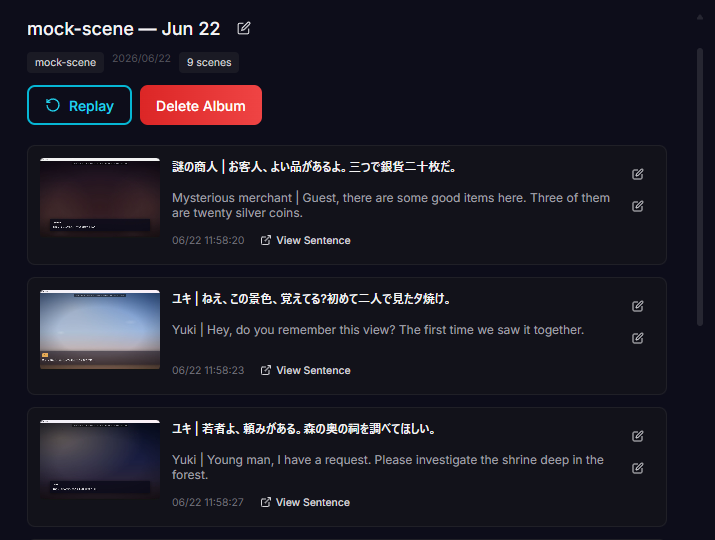
You can rename it, edit a line if the reading came out wrong, and drop scenes that didn’t turn out interesting. The screenshots live on disk, so the album is the visual record the Log alone doesn’t keep.
Replay turns the album into a memory test
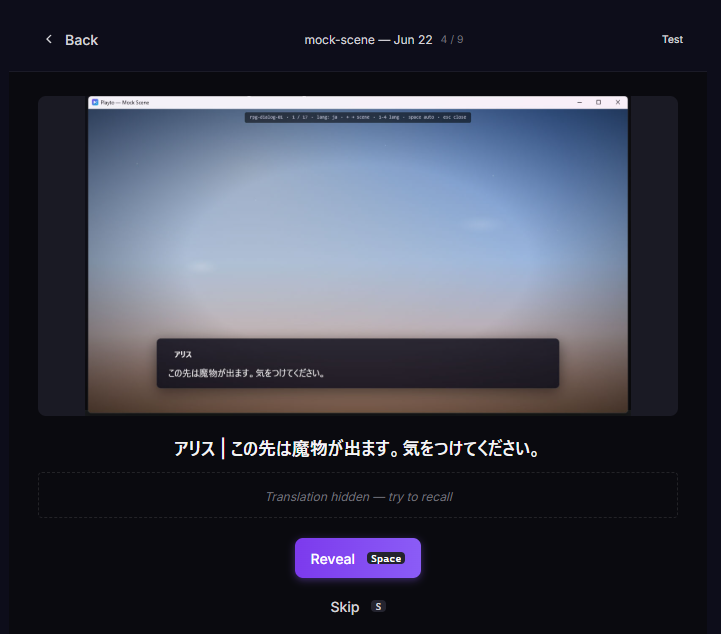
The part that makes this more than an archive is Replay. Hit it and the album plays back one scene at a time, the translation hidden. You see the original line in its screenshot and try to recall what it meant.
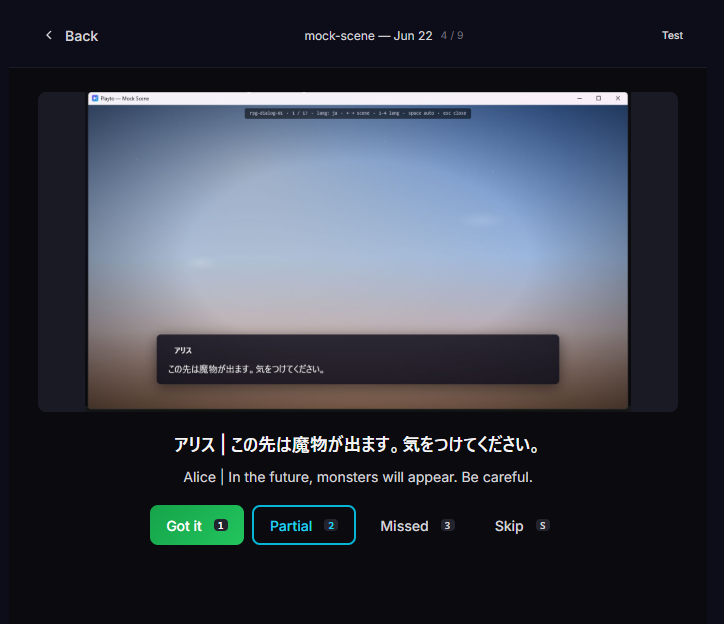
Reveal it, and you grade yourself: got it, partial, or missed. Same self-scored rhythm as a flashcard deck — but the prompt is the scene you actually played, not a line on a blank card.
Why the picture helps you remember
A line you read in a memorable moment is easier to recall than the same line on its own, because the picture gives memory more to hold onto — the face, the place, where you were in the story. When the screenshot comes back, the words tend to come back with it. Plain flashcards throw that context away; Replay keeps it and uses it as the cue.
It also keeps review honest. Seeing the scene again, you remember whether you actually understood the line at the time or just skimmed past it — and you grade accordingly.
The second playthrough, without the replay
A classic piece of language-learning advice is to play the same section of a game twice — once for the story, once for the language. The idea is sound: the second pass is where you actually read. The problem is the cost, because few people replay an hour of game to study forty lines of text.
An album is that second pass with the game taken out. You played the section once, at game speed; replaying the album walks you back through what it said at reading speed, scene by scene, while the story is still fresh. Ten minutes covers what took an hour to play. It slots naturally into the after-session routine as the collect step’s richer cousin — instead of skimming a list of saved words, you re-read the session itself.
When to use it
Replay isn’t for every session. Save an album when a stretch of a game was worth keeping — a story beat you liked, a conversation dense with new words, a quest whose wording you want to revisit. Then come back to it a day or two later and replay it as a short recall pass.
For everyday word-level review, Practice and its quiz modes are the workhorse. Album Replay is the one that brings the scene back with the line — see the full feature in the Album docs, and how saved lines feed the rest of review in from reading to remembering.